


PACE and the Everyday Way
- gbucknell
- Dec 9, 2025
- 7 min read
When the SHTF: Using PACE to Build Real-World Resilience (Not Just a Bigger Kit)
We all know the feeling.
You’re out bush, the weather turns nasty faster than forecast, a piece of kit fails, or someone twists an ankle just as the light starts to fade. In that moment, “prepared” suddenly has a very clear definition: can we cope or not?
That’s really what people mean when they talk about “SHTF” (when the stuff hits the fan) — whether it’s a personal emergency, a community crisis, or a bigger disruption. It’s less about the zombies, more about the question:
When things go wrong, do I have layers of options… or just hope?
In Everyday Bushcraft we talk about practical skills and everyday resilience, not fantasy. A powerful way to build that resilience into your kit and mindset is simple military doctrine:
PACE: Primary, Alternate, Contingency, Emergency.
PACE means you deliberately plan four layers for anything mission-critical:
Primary – what you’ll use first, in normal conditions
Alternate – your backup if the primary fails or isn’t available
Contingency – a different method altogether, slower or less convenient, but still workable
Emergency – last-ditch option to keep you alive and functioning when everything else is gone
Most people stop at Primary. A few think about an Alternate. Very few go to Contingency and Emergency – and that’s where real resilience lives.
The beauty is: PACE doesn’t mean more gear. It means better thinking and stronger skills.
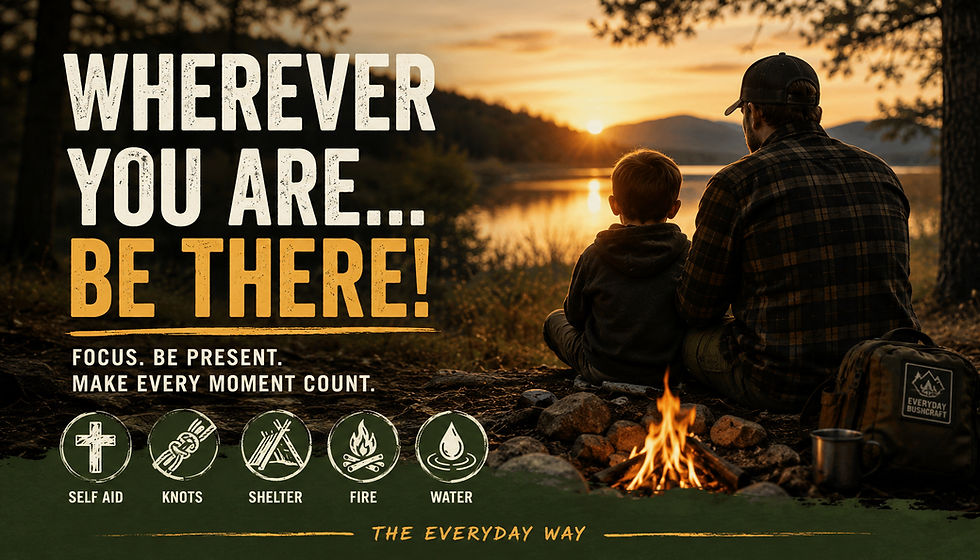
Let’s walk through how PACE applies to SHTF preparedness and how it fits perfectly with the Everyday Bushcraft 5 skills: Self-Aid, Knots, Shelter, Fire, Water.
1. Self-Aid: You Are Your First Responder
In a real SHTF moment, the most important medic is you.
PACE for Self-Aid
Primary:
A well-stocked personal first aid kit on your body (not buried at the bottom of your pack). Bandages, wound dressings, tape, pain relief, blister care, gloves, etc.
Alternate:
A more comprehensive kit in your pack or vehicle – extra dressings, splint material, triangular bandages, compression bandage, trauma items if you’re trained.
Contingency:
Shared or group resources – your buddy’s kit, first aid station at a campsite, basic supplies in a shelter or hut. You may have to move to get them.
Emergency:
Improvised self-aid: torn cloth for bandages, trekking pole or branch as a splint, belt as a sling. Your knowledge becomes the kit.
Everyday Bushcraft Connection
Self-Aid isn’t just physical. It’s the skill of looking after yourself when things go wrong – physically, mentally, emotionally.
In everyday life, PACE for Self-Aid looks like:
Primary: your normal routines – sleep, exercise, good food
Alternate: talking to a friend, mentor, or partner when stressed
Contingency: professional support – GP, counsellor, chaplain
Emergency: crisis hotlines, emergency department, calling 000
The mindset is the same: don’t rely on one fragile line of support.
2. Knots: Connection, Control, and Backup Options
Knots are about control – being able to secure, lift, pull, and fix things in place. In SHTF, that might be building a stretcher, securing a load, or rigging a shelter in high wind.
PACE for Knots & Cordage
Primary:
Good quality paracord or similar cordage on your person (bracelet, belt, or a few hanks in your pocket).
Alternate:
Bank line, guy lines, webbing straps, spare shoelaces, elastic cord in your pack.
Contingency:
Webbing from packs, seat belts from vehicles, straps from bags – repurposed as cordage when you’re short.
Emergency:
Natural cordage – vines, bark, roots, or strips torn from clothing. Slow and fiddly, but it works.
Everyday Bushcraft Connection
Knots also represent the ties in our life – relationships, commitments, responsibilities.
In the Everyday Way:
Primary “knots”: closest relationships – family, close friends
Alternate: community – Scouts, church, clubs, local groups
Contingency: online communities, support networks, neighbours
Emergency: the simple human kindness of strangers when your usual support is gone
In a crisis, whether in the bush or in life, you find out quickly: how many knots are actually tied, and how strong they are.
3. Shelter: Layers Between You and the Chaos

If you get shelter wrong, everything else gets hard very quickly. In SHTF situations, shelter might be:
Physical (hoochie, tarp, dwelling)
Environmental (shade, windbreak, elevated ground)
Social (group safety, community, a safe house)
PACE for Shelter
Primary:
Your planned shelter – tarp/hoochie, tent, swag. The setup you practice regularly.
Alternate:
Bivvy bag, emergency space blanket, poncho, or the ability to rig minimalist shelter using your pack and rain jacket.
Contingency:
Using natural features – caves (carefully), overhangs, thick tree lines, leeward sides of hills; repurposing materials to create a debris shelter.
Emergency:
Body-to-body warmth, sharing a single tarp or blanket, huddling in a tight space out of wind and rain. Not comfortable – but survivable.
Everyday Bushcraft Connection
Shelter is also about belonging and safety in community.
In life:
Primary: your home, family, routine
Alternate: extended family, friends’ places, community centres
Contingency: temporary accommodation, short-term help, church/community support
Emergency: crisis accommodation, emergency relief services
Everyday Bushcraft reminds us: we all need places (and people) where we can “weather the storm.” Good SHTF planning includes both physical shelter and social shelter.
4. Fire: Heat, Light, Morale, and Momentum
Fire is far more than flame. It’s warmth, light, the ability to cook and purify, and a huge psychological boost.
PACE for Fire
Primary:
A reliable lighter that lives on you. Ideally more than one – one in your pocket, one in your kit.
Alternate:
Ferro rod and striker, stormproof matches, timed with good tinder (cotton balls with petroleum jelly, fatwood, commercial fire starters).
Contingency:
Battery and steel wool, a magnifying lens on sunny days, char cloth with a spark source. Slower, more skill-dependent.
Emergency:
Friction fire (bow drill, hand drill) or fully improvising from found materials. This is where “knowledge weighs nothing” becomes painfully real – you either have the skill or you don’t.
Everyday Bushcraft Connection
In the Everyday Way, fire represents passion, purpose, and drive.
PACE for your “inner fire” might look like:
Primary: work, hobbies, and projects you enjoy
Alternate: side projects, volunteering, creative outlets that keep your spark alive
Contingency: taking a course, changing direction, small steps that reconnect you with meaning
Emergency: reaching out when you’ve burned out completely – asking for help, resetting your life priorities, reclaiming your purpose
When SHTF in life, the question becomes: What keeps your fire alive when normal fuel disappears?
5. Water: Clarity, Flow, and the Ability to Filter
We can last 3 weeks without food. Without water, we have 3 days. In any SHTF scenario, water is non-negotiable.
PACE for Water
Primary:
Enough clean water carried for your activity, in reliable bottles or bladders.
Alternate:
A quality water filter, combined with knowledge of where to find natural water sources in your area.
Contingency:
Purification tablets, boiling, or chemical treatment (e.g. iodine, chlorine-based tabs) when filtration isn’t possible.
Emergency:
Solar stills, basic sedimentation and improvised filtration, careful selection of the least-risky source, and rationing. It’s not ideal – just enough to stay alive.
Everyday Bushcraft Connection
Water is also about mental clarity and what we allow into our head and heart.
In everyday life:
Primary: healthy information “diet” – good books, helpful news, quality conversations
Alternate: mentors, courses, podcasts, faith, or philosophy that help you make sense of things
Contingency: stepping away from toxic input – social media breaks, limiting news, simplifying your life
Emergency: when everything feels muddy, you strip back to basics: sleep, hydration, prayer/meditation, short walks in nature, talking to someone you trust
PACE in this sense is about filtering, not just drinking – choosing what sustains you instead of poisons you.

PACE + The Everyday Bushcraft Philosophy
So how does all this tie together?
PACE turns “just-in-case” into “on-purpose”
Instead of throwing random gear into a bag, you ask:
What’s my Primary for each skill?
What’s my Alternate?
If those fail, what’s my Contingency?
If it all goes sideways, what’s my Emergency option?
Skills > Stuff
The deeper you go into PACE, the more you notice:
Primaries and alternates are often gear-based.
Contingency and emergency rely heavily on knowledge, practice, and mindset.
That’s Everyday Bushcraft in a nutshell: you train the human first, gear second.
Layered Resilience, Not Fragile Comfort
In comfortable times, it’s easy to rely on one solution: the lighter, the phone, the car, the supermarket. PACE reminds us that when SHTF – big or small – the people who cope best are those with layers of options.
SHTF Isn’t Always Apocalyptic
Sometimes “SHTF” is just:
Your car breaking down in the middle of nowhere
A storm knocking out power for a few days
Losing a job, getting sick, or a family emergency
Everyday Bushcraft uses the 5 skills + PACE to prepare you for those moments – the real ones.
Building Your Own PACE-Based Kit
If you want to start right now, grab a notebook and work through:
For each of the 5 skills:
Self-Aid – What is my:
Primary?
Alternate?
Contingency?
Emergency (improvised) option?
Knots (Cordage) – What do I actually carry? What can I improvise?
Shelter – Can I stay dry and out of the wind if my tent fails? What if I lose my pack?
Fire – How many methods can I reliably use, even cold, wet, and tired?
Water – Can I find, filter, and purify water in the places I actually go?
Then ask the same questions for your everyday life:
How do I look after myself when things go wrong?
Who are my support “knots”?
Where is my social/emotional “shelter”?
What keeps my inner “fire” burning?
How do I “filter” what I let into my mind and life?
That’s the Everyday Way: using bushcraft not just to survive a night in the bush, but to prepare for the storms of life with calm, confidence, and layered options.
If you’d like help building a PACE-based Everyday Bushcraft kit – and the skills to back it up – that’s exactly what our courses are designed to do. We don’t just give you gear; we help you become the kind of person who can handle it when the SHTF… and still find a way forward.


Comments