


Rediscovering Rite of Passage
- gbucknell
- Nov 19, 2025
- 4 min read
Why Modern Society Needs Tribal Traditions Again
And how Everyday Bushcraft can help families and communities build their own initiation rituals
For most of human history, young people didn’t simply “grow up.”
They were brought up—guided, shaped, and initiated by their tribe, their clan, their elders, and their community.
Across cultures and continents—from Aboriginal songlines to Celtic coming-of-age trials, from First Nations vision quests to the African semanā initiation ceremonies—young men and women were formally recognised, taught responsibility, and welcomed into adulthood with purpose.
These rites weren’t just symbolic.
They gave young people three things modern society struggles to provide:
Belonging – a tribe to stand with
Identity – clarity about who they are
Responsibility – a meaningful role within the community
Yet today, most of these ancient traditions have faded into memory.
We send young people through school, test them, grade them, push them through a system—but when they emerge at the end, they often step into the world directionless, anxious, overwhelmed, or feeling like they are “not enough.”
They graduate with certificates, but often without confidence, without mentorship, and without any ceremonial transition into their community.
And something deep inside them knows something is missing.
The Lost Transition: Why It Matters More Than Ever
Growing up used to be marked by clear milestones—moments that said:
“You belong here.
You matter here.
You are ready.”
Without these moments, many young people drift.
They search for identity in:
online communities
peer pressure
risky behaviour
emotional withdrawal
achievement addiction
or hollow digital validation
Young people aren’t failing.
We’ve failed to initiate them.
When there is no clear threshold between “child” and “adult,” the journey becomes confusing, lonely, and self-directed at a time when it should be guided.
This is where the old ways offer wisdom, and where the modern Everyday Bushcraft approach can bridge the gap.
How Bushcraft Helps Rebuild These Lost Pathways
Everyday Bushcraft is far more than fire, shelter, rope and water.
It is a framework for resilience, identity, and purpose.
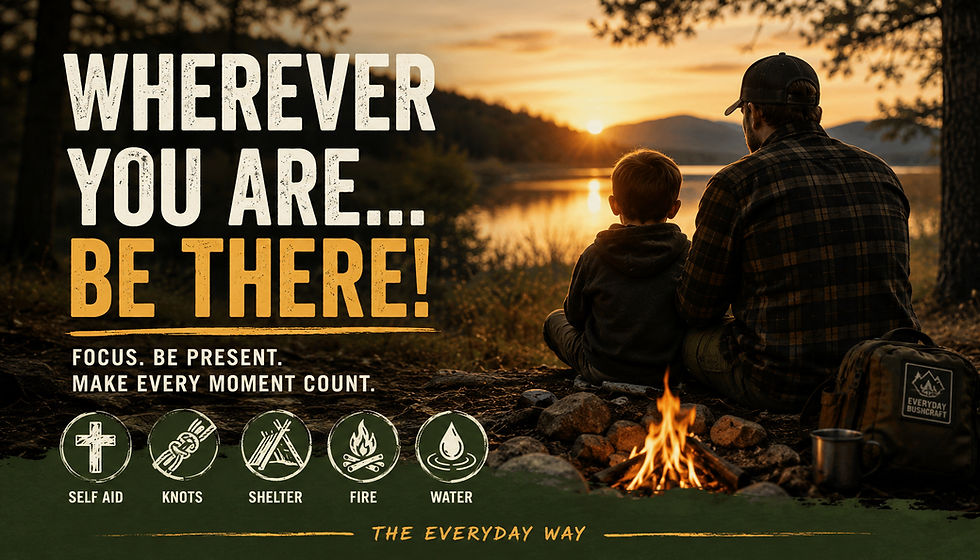
Our five core skills mirror the foundational elements of ancient rites of passage:
1. Self-Aid – Responsibility for Self
Initiation begins with learning to care for yourself—physically, mentally, emotionally.
It says: You can handle things. You are competent.
2. Knots – Connection and Problem-Solving
Young people learn how to tie things together, fix what is broken, and become dependable—skills mirrored in building human relationships and community ties.
3. Shelter – The Gift of Protection and Belonging
Every tribe teaches its youth how to stay safe, create space, and build community.
Shelter is the metaphor for belonging: “Who and what keeps you safe?”
4. Fire – Purpose, Passion, and Transformation
Fire is the ancient symbol of adulthood—energy, responsibility, creativity.
Learning to make fire is learning to command your inner flame.
5. Water – Clarity, Calm, and Filtering Out the Noise
Young people learn to think clearly, make decisions, and filter what serves them from what harms them.
Bushcraft brings young people back into challenge, learning, ritual, and identity—all while reconnecting them with family, mentors, and community.
Designing a Modern Rite of Passage: The Youth Initiation Camp
Imagine this:
A weekend in the Australian bush.
No screens.
No noise.
Just parents, mentors, and young people stepping into their next stage of life.
An Everyday Bushcraft Initiation Camp might include:
🔹 Skill Challenges
Navigate using map and compass
Build a safe shelter
Make fire responsibly
Purify water
Tie survival knots
Demonstrate situational awareness
These challenges aren’t just practical—they build confidence, competence, and calm under pressure.
🔹 Guided Reflection
Around the campfire, each young person reflects on:
Who they are
What they value
What strengths they carry
How they want to contribute
🔹 Family Ritual
This could be co-designed with parents or carers:
A family totem or symbol
A personal “acceptance statement” from parents
A gifted object (e.g., knife, compass, bracelet, woggle) representing adulthood
A shared family pledge
🔹 Community Welcome Ceremony
Around the final campfire:
Mentors and parents formally welcome each youth as an emerging adult
Young people declare their strengths, hopes, and responsibilities
They step over a symbolic threshold (often a line, log, flame, or trail)
This becomes their moment—a memory that shapes identity for life.
Why This Matters Now
The world is changing rapidly.
But humans haven’t.
Young people still crave:
belonging
purpose
identity
challenge
recognition
responsibility
mentorship
They need something real.
Ancient cultures understood this deeply.
Modern society is beginning to remember.
And Everyday Bushcraft is uniquely positioned to guide that rediscovery—bridging old wisdom with modern insight, wrapped in resilience, confidence, and community.
Final Thought
Initiation isn’t about harsh trials or outdated rituals.
It’s about giving young people what they deserve:
A moment that says:
“We see you.
We trust you.
You are ready to take your place with us.”
If you’re interested in exploring a Youth Initiation Camp or co-creating a family rite of passage, Everyday Bushcraft would love to partner with you.
This is how we rebuild resilience.
This is how we rebuild community.
This is how we raise confident young adults again.
One skill. One flame. One young person at a time.


Comments