


Training for Life
- gbucknell
- Feb 16
- 3 min read
We Don’t Train for Extreme Survival. We Train for Life.
When people hear the word bushcraft, they often picture dramatic survival scenes — building shelters in storms, eating strange plants, or pushing through extreme hardship with nothing but a knife and grit.
That’s not what we do.
At Everyday Bushcraft, we don’t train people to survive the apocalypse.
We teach practical skills that build resilience, confidence, and capability — in the bush and in everyday life.
Because the truth is, most people won’t face extreme survival situations.
But everyone will face challenge.
Everyone will face uncertainty.
Everyone will face moments where they need calm thinking, practical skills, and belief in themselves.
That’s what we train for.
Skills That Build More Than Skill
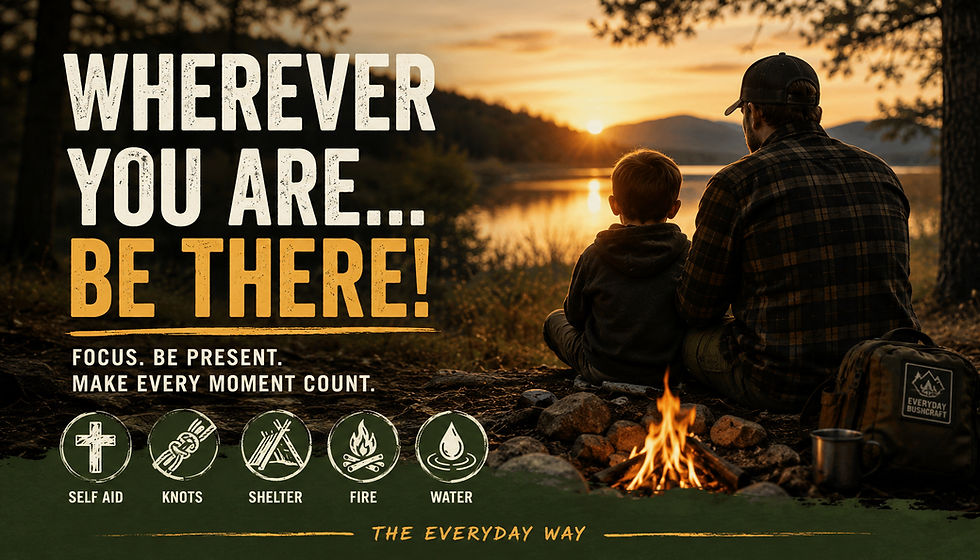
Our core areas — self-aid, knots, shelter, fire, water, and situational awareness — are deliberately simple.
They are accessible.
They are practical.
They are repeatable.
A child learning to tie a reliable knot isn’t just learning cordage. They’re learning patience, persistence, and problem-solving.
A parent learning to light a fire without frustration isn’t just making flame. They’re learning calm under pressure.
Building a shelter isn’t about surviving a blizzard. It’s about teamwork, planning, and adapting when something doesn’t go to plan.
Finding and purifying water isn’t about drama. It’s about understanding systems and thinking ahead.
Practising situational awareness isn’t about paranoia. It’s about paying attention, reading context, and making better decisions.
These are life skills disguised as outdoor skills.
Resilience Is Built in Small Moments
Resilience doesn’t come from one extreme experience.
It comes from repeated small wins.
It comes from:
Struggling slightly.
Adjusting.
Trying again.
Succeeding.
Reflecting.
When students realise they can solve a problem with their own hands and thinking, something shifts.
They stand a little taller.
They speak with more certainty.
They begin to trust themselves.
That trust carries into school, work, relationships, and difficult conversations.
Confidence is rarely loud. It is quiet and steady — built through doing.
The Bush Is a Classroom, Not a Battlefield
We use the bush as a training ground because it offers honest feedback.
If your shelter leaks, you improve it.
If your fire won’t light, you refine your technique.
If your plan doesn’t work, you adapt.
Nature doesn’t criticise.
It simply responds.
And that makes it one of the best teachers available.
There’s no need for extreme scenarios to create growth. In fact, extreme environments can overwhelm learning. Real development happens at the edge of comfort — where challenge stretches you but doesn’t break you.
We aim to operate in that zone.
Confidence Through Capability
Modern life has made many of us consumers rather than creators.
We press buttons.
We order online.
We scroll.
But there’s something powerful about creating something with your own effort:
A working knot.
A stable shelter.
A flame from spark.
Clean water from a questionable source.
A clear decision made under pressure.
Capability builds confidence.
Confidence builds resilience.
Resilience builds better humans.
And better humans build stronger families and communities.
Skills for the Bush. Skills for Life.
When someone finishes a one-day program with us, we don’t expect them to trek into the wilderness for weeks.
We expect something more valuable:
A child who believes they can handle challenge.
A teenager who understands awareness and risk.
A parent who feels capable instead of overwhelmed.
A family who has learned together.
The bushcraft skills are the vehicle.
The destination is resilience.
The outcome is confidence.
The Real Goal
We don’t chase extreme survival stories. We build steady, capable people. Because life doesn’t usually demand heroics.
It demands clarity.
It demands responsibility.
It demands calm thinking when things go wrong.
And those are skills you can practise — one knot, one spark, one small success at a time.
That’s Everyday Bushcraft.
Not extreme survival.
Just practical skills that quietly shape stronger people.


Comments